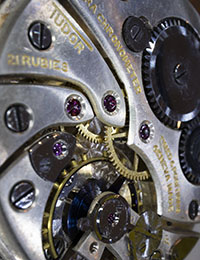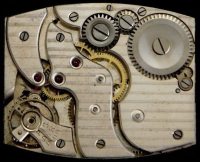

Well, what you are painting is some romantical picture based on nothing but emotionsdjolemag wrote: ↑May 12th, 2020, 3:20 am
Why do you think it would be more plausible ?
Cortebert was one of the most inventing company of that time, so in that terms, Cortebert seems much more as "meister" to Unitas than vice verse.... Especially if we look at roots and tradition, since Cortebert is founded in 1790, right? Disclaimer: it is just mine personal opinion
Mistery about similarity of Cortebert 727 and UT 285, same as Cortebert 736 <=> UT 6431 is still unsolved, in terms who is father and who is son... Common sense says that Cortebert as old vendor of pocket watches had more resources to produce ebauche to Unitas. On the other hand, economic logic says that Cortebert cut expenses by making specific orders from Unitas.... We all know about Cortebert pocket watches with Unitas 6497/8 and 6431/6445 movements...
Keyless work is not so important in that comparison, it is usually different in much more similar models from same vendor and in same family of movements...
My point of view is that Cortebert somehow "payed a debt" after WW2 for being in tight cooperation with Italy, through Perseo brand etc. More to add, we are all aware of similarity of Molnia and Cortebert movements, which 'strangely' occurs after WW2... so it could be a part of "war damage". Maybe Soviet Union just took machines or copycat movement (Cort 620) or it is done through some other sort of "cooperation", who knows...
There are rumors that Cortebert records vanished in fire during 1950, symptomatic?
Finally, Omega bought Cortebert in 1962, that is a weird fact I found recently somewhere on web...


On the other hand I am talking simply about the known facts. And there are no facts which would support the idea that 6497 is a development of Cortebert. Because, as I already said - there is clear lineage from the 85 to 6487.
You did offhand dismiss the keyless works, but actually keyless is the main thing by which the movements are differentiated in Flume and all other sources. Not by the looks (bridge form) or anything else. Why? Well, because bridge form might be easily changed to get a different look, but keyless stays the same, because it's hidden under the dial. And when you inspect keyless works on 85, 285, 6497 it becomes very obvious, that it's the development of the same system:
http://www.ranfft.de/cgi-bin/bidfun-db. ... &Unitas_85
http://www.ranfft.de/cgi-bin/bidfun-db. ... Unitas_285
http://www.ranfft.de/cgi-bin/bidfun-db. ... ETA_6497_1
Cortebert 727 has the same keyless as 285. And 61X/62X does not fit here anywhere.
You are saying that "Mistery about similarity of Cortebert 727 and UT 285, same as Cortebert 736 <=> UT 6431 is still unsolved, in terms who is father and who is son...", but that's simply not true, if we use logic and common sense as you suggested.
We know that so called Cortebert 727 is UT285 by other name. If we were to use common sense, then it's logical to conclude, that it's just a variation of UT285 with different bridgeform (and I know of 3 different 285 bridgeforms besides this one). Because other option is to try to invent some weird ahistorical way in which 285 is a development of the 727, which then shoul be development of 6XX. And that would be totally illogical, not only because of the obvious geneology between 85 and 285 (not only keyless on these movements is very similar, but they can be found with exactly the same bridgeforms). But if that were the case, then 85 has to be development of 727 too, and that doesn't fit with the known chronology at all, because then 85 would be a develpoment of the movement which was made some 20 years later.
And the fact that Cortebert pocket watches did use 6497 and 6431 movements shows, that Cortebert did use UT movements. Not the other way around! We have no known Unitas (or even Arsa) watches with Cortebert movements...
Molnija story is an interesting one, but it's neither here nor there in this discussion.